
A property business we worked with had already invested in the software it needed. There was a system for customer and property records, another for day-to-day work, accounting software for the money, shared documents for information that did not fit neatly elsewhere, and email holding the conversations around all of it. Each tool did a useful job. The problem lived in the gaps between them.
Staff were copying the same details from one place to another, checking several screens before answering a routine query and maintaining spreadsheets so that managers could see what was happening. A change to a property or customer could be correct in one system and stale in another. Important work depended on somebody remembering the next step and sending the right message.
Replacing everything with one large platform would have been disruptive, expensive and difficult to justify. The existing systems contained years of useful information, and the team already knew how to use them. We took a different route: keep the software that worked, define which system owned each piece of information, and build the missing connections around the actual operating process.
We Started With One Complete Journey
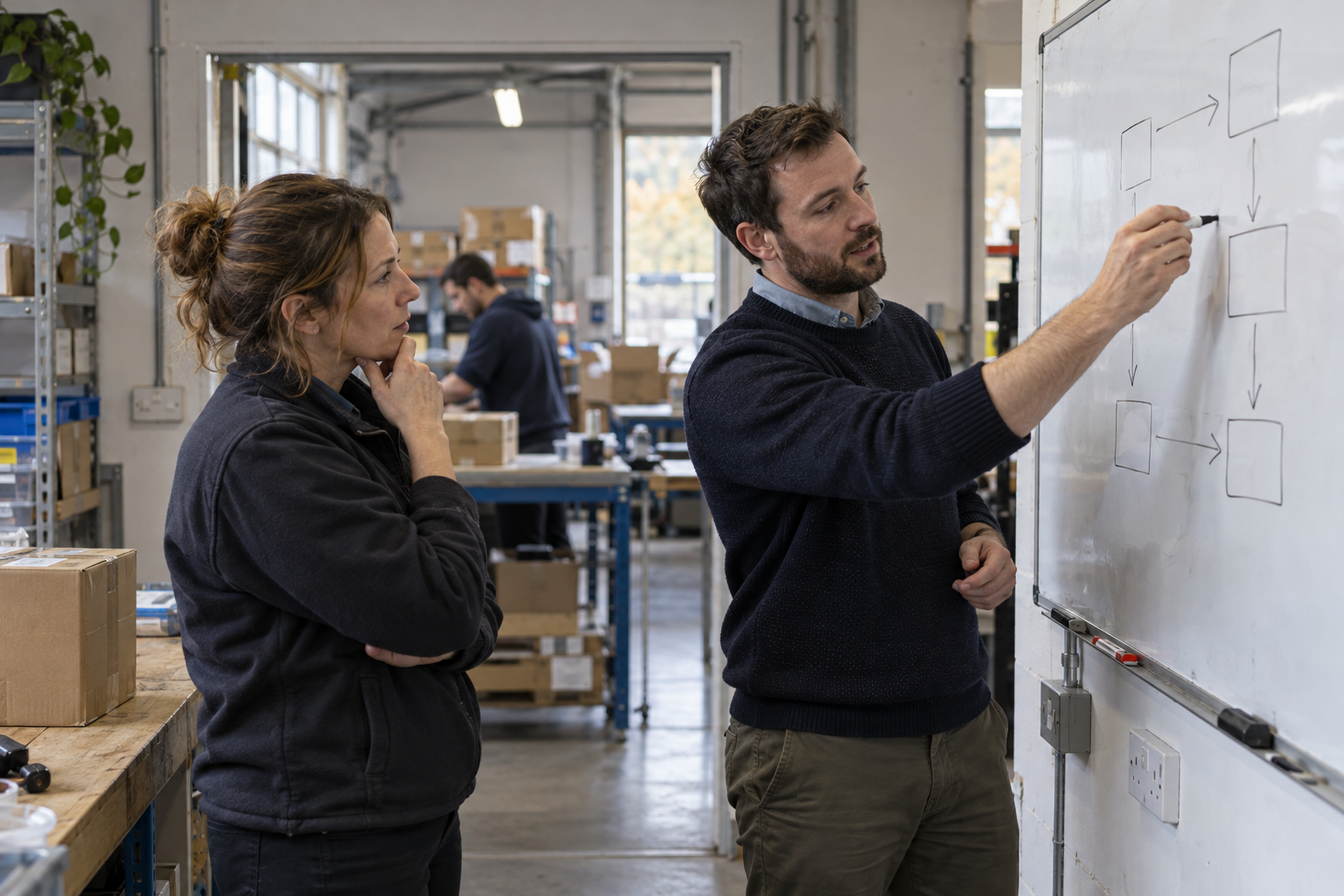
The first job was understanding how work moved through the business. That meant following a real case from the moment information arrived to the point where the team and customer had the outcome they needed. We looked at who received it, which records they opened, what they copied, where they made a judgement and how another person knew it was their turn.
This exposed more than a diagram of software. It showed the unofficial process that made the official process function: spreadsheet columns used as a temporary queue, inbox folders treated as status markers, saved email wording, notes kept because the main system lacked a suitable field, and checks that existed only in an experienced employee's head.
We chose a repeated operational journey with a clear beginning and end. A request or update arrived, staff identified the relevant property and people, checked the information, created or changed records, assigned follow-up work and communicated the result. The exact systems are less important than the pattern. It appears across lettings, serviced accommodation, property management and development businesses, especially where several specialist tools have accumulated over time.
Each Existing System Kept a Clear Job
Connecting software safely requires a decision about ownership. If two systems can both change the same address, status or customer detail, an automation can make inconsistency travel faster. We agreed which system was authoritative for each important record and treated every other copy as a view or controlled handoff.
The property or customer platform remained the home for its core records. The accounting package continued to own invoices, payments and financial status. Documents stayed in the shared storage the team already used. The new layer did not pretend to be another master database. It moved approved information between those systems, kept the relevant identifiers together and recorded what happened.
Some connections used supported APIs, which allowed software to read or update records directly. Where an older product offered limited integration, we used safer alternatives such as structured imports, monitored exports or a small staff-facing step that prepared the data for confirmation. The aim was reliable progress, not forcing every product into a fully automatic route it was never designed to support.
Routine Work Moved, Exceptions Became More Visible
For an ordinary case, the automation could collect the incoming details, match them to the correct property record and prepare the updates needed elsewhere. It checked required information before creating follow-up work, carried the existing reference numbers forward and notified the appropriate person. The team no longer had to search three systems and retype the same names, dates and contact details to move a straightforward case along.
Cases with missing or conflicting information stopped instead of being guessed. A duplicate property match, an unusual commercial decision, an unrecognised customer or a financial discrepancy went into a clear review queue with the source material attached. Staff could see why the case had paused and what decision was needed. Once resolved, the journey continued without somebody rebuilding it from the beginning.
This distinction was important. Property work contains judgement, sensitive information and consequences for real people. Automation was useful because it handled the predictable administration and made exceptions easier to manage. It did not make tenancy, financial or operational decisions simply because the technology could update a field.
We Introduced the Change in Small Sections
The early version observed and prepared more than it changed. We compared its property matches and proposed actions with the work staff completed manually. That revealed naming differences, old references and edge cases that would have been missed in a workshop. It also gave the team confidence that the system understood the normal route before it was allowed to perform updates.
We then enabled one bounded action at a time. Each action kept the original input, the record it matched, the changes made and any error returned by the existing software. If a connection failed, the case stayed visible and could be completed manually. The team never had to wonder whether a quiet failure had left a customer waiting.
This staged approach also protected the day-to-day operation. People continued using familiar tools while repetitive steps gradually disappeared. Training focused on the new review queue and exception handling rather than teaching the whole business a replacement platform at once.
The Improvement Was in the Handoffs
The most useful measures were operational rather than technical. We looked at how long a routine case waited before somebody picked it up, how often staff re-entered information, how many cases needed correction and how easily a manager could see outstanding work. We also checked whether customers received faster, more consistent updates and whether staff had more time for work that genuinely needed property knowledge.
The result was a more joined-up operation without a risky software replacement programme. Existing licences and staff knowledge retained their value. Information moved with fewer manual interventions, and the business gained a clearer record of where each case had reached. When an exception occurred, it appeared as owned work rather than another message buried in an inbox.
There are still maintenance responsibilities. APIs change, business rules evolve and new exception types appear. Someone must own the connected process, review failures and decide when an existing product no longer serves the business. Integration avoids unnecessary replacement, but it does not remove the need for sensible operational ownership.
Keep What Works and Fix What Happens Between It
A collection of established systems is not automatically a technology problem. Often the waste comes from the human bridges between them: copying identifiers, checking for updates, creating the next task and telling somebody that a status changed. Those bridges are good candidates for focused automation because the business can improve the complete journey without discarding working software.
The starting point is a specific operational route, not a general ambition to connect everything. Decide where each important record belongs, automate the stable handoffs, stop uncertain cases for review and measure whether the work reaches its outcome faster and with fewer corrections.
Birdcage Tech builds bespoke software and automation around the systems businesses already use. If your property operation depends on spreadsheets and repeated copying between otherwise useful tools, we can help identify a practical first connection.